

Your Assets, Our Expertise, Your Success.
Demonstrating Engineering Capability Through Robust PFMEA and DFMEA
AMREP Australia recently completed a comprehensive body of Process Failure Modes and Effects Analysis (PFMEA) and Design Failure Modes and Effects Analysis (DFMEA) works for a client seeking to strengthen how their engineered product is perceived by customers. The focus of the engagement was not limited to internal engineering assurance; it was explicitly designed to help the client demonstrate product maturity, reliability, and governability in a way that external stakeholders could readily understand and trust.
In many markets, particularly those involving critical infrastructure, energy systems, data centres, and asset‑intensive environments, customers are increasingly sophisticated in how they evaluate suppliers. They no longer assess products solely on technical specifications or price. Instead, they look for evidence that risks have been identified early, evaluated systematically, and controlled consistently across design, manufacture, and operational use. PFMEA and DFMEA are central to providing that evidence.
The completed PFMEA and DFMEA framework now allows the client to clearly articulate how their product behaves under normal, abnormal, and degraded conditions. It shows how design assumptions were tested, how failure modes were anticipated, and how controls were deliberately selected rather than retrofitted. This clarity directly supports customer confidence, tender evaluations, and supplier qualification processes.
From a commercial perspective, this level of demonstrated engineering capability reduces buyer uncertainty. It helps customers answer the unspoken question: “Has this supplier thought through the failure scenarios before delivering the product?” By enabling that confidence, robust PFMEA and DFMEA become not just engineering tools, but sales‑enabling artefacts.

Moving Beyond Compliance: PFMEA & DFMEA as Capability Evidence
PFMEA and DFMEA are often initiated in response to a contractual, regulatory, or customer requirement. While compliance may be the trigger, it rarely satisfies what customers truly want to see. Buyers assessing product maturity are looking for capability signals, evidence that engineering decisions are deliberate, repeatable, and governed by a structured risk management process.
AMREP’s approach moved the PFMEA and DFMEA well beyond checkbox compliance. The analysis was structured to clearly communicate why certain risks exist, how they are controlled, and what happens if those controls fail. Assumptions, interfaces, and constraints were explicitly documented so that the resulting artefacts provide context, not just scores or tables.
For organisations selling engineered products, this distinction is critical. A compliance‑driven FMEA often appears defensive and opaque. A capability‑driven FMEA, by contrast, supports open conversation with customers and auditors. It demonstrates that the organisation understands its own product deeply and is willing to be transparent about its limitations and improvement actions.
By reframing PFMEA and DFMEA as evidence of organisational maturity rather than regulatory burden, the client is now better positioned to respond to technical due diligence, pre‑qualification questionnaires, and customer audits. This directly improves bid credibility and reduces the friction commonly experienced during late‑stage commercial negotiations.

Linking DFMEA and PFMEA Across the Product Lifecycle
One of the key indicators of product maturity is whether design intent is consistently translated into manufacturing outcomes and sustained through operational use. Customers are acutely aware that many failures occur not because of poor design, but because of misalignment between design assumptions, manufacturing practices, and real‑world operating conditions.
The PFMEA and DFMEA developed through this engagement explicitly link design‑level risks to manufacturing processes and onward to operational and maintenance controls. The DFMEA captured how the product could fail due to design choices, while the PFMEA demonstrated how manufacturing steps, inspections, and error‑proofing controls manage those risks during production and commissioning.
For customers, this linkage is powerful. It shows that risks are not addressed in isolation or siloed within departments. Instead, there is continuity of thinking across the lifecycle of the product. This reassures buyers that reliability, safety, and performance characteristics are not lost as the product moves from engineering drawings to the factory floor and into service.
From a sales perspective, this integrated approach supports stronger claims around reliability and suitability for purpose. It enables the supplier to demonstrate that the product behaves as intended not just on paper, but throughout its operational life, supporting long‑term customer value and reduced whole‑of‑life cost.

Using PFMEA and DFMEA to Improve Customer Confidence
Sophisticated customers understand that no engineered product is entirely risk‑free. What they look for instead is transparency, a clear communication of where risks exist, how they are controlled, and what actions are in place to manage residual exposure. The PFMEA and DFMEA works delivered by AMREP were deliberately structured to support this transparency.
Assumptions, interfaces with third‑party systems, control ownership, and outstanding actions were all explicitly documented. Rather than attempting to present a flawless picture, the artefacts provide a realistic, evidence‑based representation of the product’s risk profile. For customers, this openness is a strong indicator of organisational maturity.
This transparency changes the nature of customer engagement. Instead of discovering limitations late in a project, customers can engage early with the supplier around constraints, trade‑offs, and mitigation strategies. This reduces commercial risk for both parties and builds trust during the pre‑contract and delivery phases.
In competitive markets, suppliers who communicate risk clearly are often preferred over those who oversimplify or obscure it. By using PFMEA and DFMEA as communication tools, the client is now better equipped to build credibility, shorten approval cycles, and strengthen long‑term customer relationships.

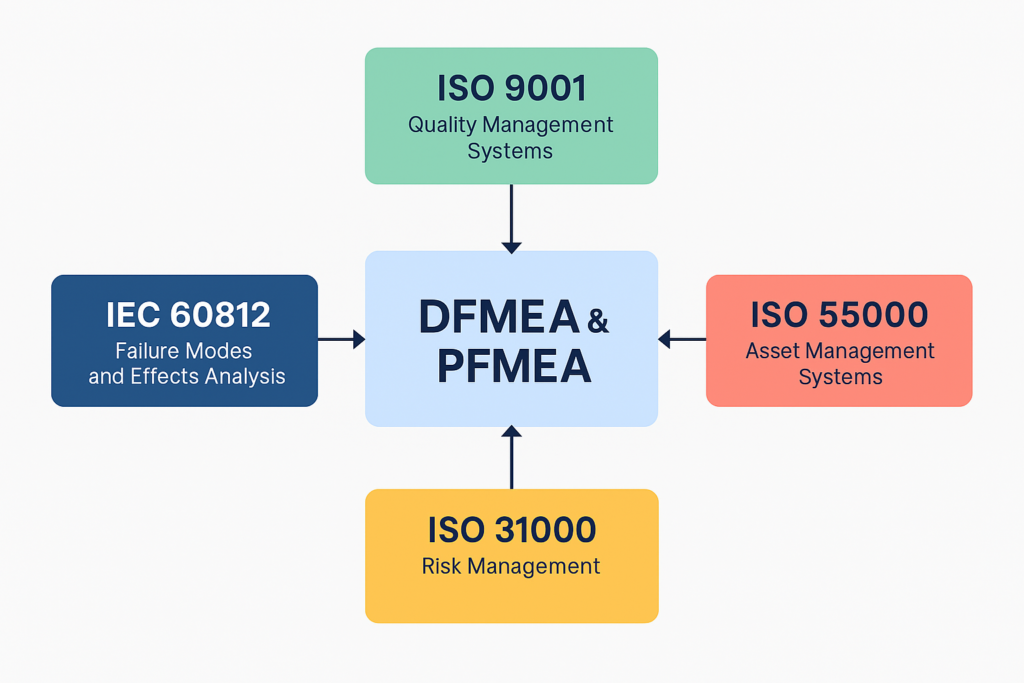
How PFMEA and DFMEA improve alignment with ISO 9001, ISO 55000, IEC 60812, and ISO 31000
Organisations selling engineered products are increasingly assessed not only on what they deliver, but on how consistently and repeatably they manage risk, quality, and lifecycle performance. Standards such as ISO 9001 (Quality Management Systems – QMS) and ISO 55001 (Asset Management Systems) define expectations for governance, decision‑making, and control but they do not prescribe how risks are to be analysed at the product level. PFMEA and DFMEA provide the practical mechanism that translates these high‑level requirements into demonstrable engineering evidence.
PFMEA and DFMEA as the Operational Expression of Management System Standards.
AS/NZS IEC 60812:2020 sits at this operational layer, defining how Failure Modes and Effects Analysis is planned, executed, documented, and maintained across the lifecycle. When PFMEA and DFMEA are applied in alignment with IEC 60812, they provide the traceable artefacts that auditors, customers, and assurance bodies expect to see when evaluating ISO‑aligned management systems. In essence, PFMEA and DFMEA make management system intent visible at the product level.
ISO 9001 Alignment: Risk‑Based Thinking, Design Control, and Process Assurance
ISO 9001 places strong emphasis on risk‑based thinking, particularly within clauses addressing design and development planning, operational control, prevention of nonconformity, and continuous improvement. DFMEA aligns directly with these requirements by identifying how a product’s design can fail to meet customer, regulatory, or performance expectations, and by documenting the controls used to prevent or detect those failures before release.
PFMEA strengthens ISO 9001 alignment by evidencing that manufacturing, assembly, testing, and commissioning processes are deliberately designed to produce conforming outputs. Failure modes within the process such as variation, human error, or inspection weakness are analysed and mitigated in a structured, repeatable way. Together, DFMEA and PFMEA provide objective evidence that quality is designed in, not inspected in, which is fundamental to ISO 9001 conformance.
Critically, these FMEA activities also support ISO 9001 clauses related to design changes and control of change. By capturing assumptions, interfaces, and action tracking within the FMEA framework, organisations can demonstrate that changes are assessed for risk impact before implementation—reducing unintended consequences and reinforcing customer confidence in stable product performance.
ISO 55000 Alignment: Lifecycle Value, Performance, and Risk Control
ISO 55000 and ISO 55001 shift the focus from delivery to whole‑of‑life value realisation of assets. Customers operating long‑life or mission‑critical equipment expect suppliers to demonstrate that reliability, maintainability, and operational risk have been considered beyond initial handover. DFMEA directly supports this expectation by analysing failure modes associated with operation, maintenance, degradation, and human interaction.
IEC 60812 explicitly requires DFMEA to consider the full lifecycle behaviour of the product, which aligns strongly with ISO 55000 principles around lifecycle planning and sustained performance. By documenting how design features support safe operation, accessible maintenance, and controlled degradation, DFMEA becomes a key source of evidence that asset risks are understood in the context of long‑term service, not just manufacture.
PFMEA complements this lifecycle view by managing risks introduced during manufacturing and commissioning that could compromise future asset performance. In ISO 55000 terms, PFMEA demonstrates that short‑term production pressures are governed in a way that protects long‑term asset value, reliability, and safety—an essential consideration for asset owners and operators.
ISO 31000 Alignment: Structured Risk Identification, Analysis, and Evaluation
ISO 31000 provides the overarching framework for risk management, defining how risks are identified, analysed, evaluated, treated, and monitored. PFMEA and DFMEA, when applied in accordance with IEC 60812, serve as formal risk assessment techniques within the ISO 31000 framework, particularly at the engineering and process level.
DFMEA and PFMEA explicitly address ISO 31000 requirements by identifying risk sources (failure modes), analysing likelihood, consequence, and detection, and evaluating residual risk against defined tolerance thresholds. Assumptions, boundaries, participants, and authoritative documents—required under IEC 60812—align directly with ISO 31000’s emphasis on establishing context before risk assessment takes place.
Importantly, ISO 31000 also requires that risk treatment actions are documented, owned, and monitored. The actions registers and control plans derived from PFMEA and DFMEA provide this evidence. This ensures that risk management is active and ongoing, rather than static or symbolic, strengthening confidence for customers and auditors alike.
Integrating Standards at the Product Level Through FMEA
What distinguishes mature organisations is not mere compliance with multiple standards, but their ability to integrate those standards coherently. PFMEA and DFMEA act as the integration point where ISO 9001 quality requirements, ISO 55000 asset lifecycle principles, ISO 31000 risk management, and IEC 60812 methodology converge into a single, product‑focused evidence set.
At this level, decision‑making becomes traceable. Design choices, process controls, maintenance strategies, and change decisions can all be linked back to structured risk assessments. This reduces reliance on tribal knowledge and individual expertise, replacing it with documented organisational competence, an important signal of maturity for customers assessing long‑term suppliers.
For salable products, this integration matters commercially. Buyers gain confidence that what is being sold today will behave as expected tomorrow, under foreseeable conditions, and across the intended life of the product. That confidence is increasingly a selection criterion.
Why This Alignment Matters to Customers and Markets
Customers rarely audit standards for their own sake; they assess what those standards say about risk, reliability, and delivery confidence. PFMEA and DFMEA provide the tangible proof that ISO‑aligned management systems are functioning effectively at the product level, where failure consequences are real and measurable.
By explicitly aligning DFMEA and PFMEA with IEC 60812, ISO 31000, ISO 9001, and ISO 55000, organisations can demonstrate that their product maturity is not aspirational but evidenced. This supports faster approvals, stronger tender positions, reduced assurance friction, and clearer differentiation in competitive markets.
For organisations seeking to sell complex or critical products, this standards‑driven, evidence‑based approach transforms PFMEA and DFMEA from internal engineering tools into customer‑facing assurance mechanisms, directly supporting trust, credibility, and long‑term commercial value.

PFMEA & DFMEA: Enabling Better Conversations With your Customers
A mature PFMEA and DFMEA does more than manage risk, it enables higher‑quality conversations with customers. Rather than responding defensively to isolated technical questions, the supplier can present a coherent narrative explaining how risks were identified, how controls were selected, and how residual risks align with customer expectations. Evidence of a PFMEA and DFMEA provide confidence to your customers that you have a mature understanding of your business, ho wit manages risk in design and manufacture.
The outputs from this engagement allow the client to engage customers in informed discussions about scope, performance boundaries, maintenance requirements, and shared responsibilities. These conversations are grounded in evidence rather than opinion, reducing ambiguity and misalignment during contract negotiation.
For customers, this demonstrates that the supplier understands the downstream consequences of design and process decisions. It signals that the organisation is capable of thinking beyond immediate delivery and considering long‑term operational performance, maintainability, and reliability.
This capability is increasingly important in markets where customers seek long‑term partners rather than transactional suppliers. By enabling structured, risk‑informed dialogue, PFMEA and DFMEA directly support stronger commercial outcomes and more resilient customer relationships.
The content of the DFMEA and PFMEA example to the client not only your current state of maturity but also that you are in the process continually improving. A DFMEA and PFMEA document which calls out improvement actions and lessons learned stands as a record of an organisations dedication to internal and product improvement.

A Practical, Action‑Driven Outcome
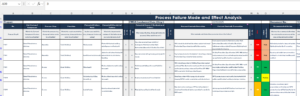
True product maturity is demonstrated not by the absence of risks, but by how effectively risks are managed over time. The PFMEA and DFMEA delivered by AMREP intentionally capture actions that remain open, along with ownership, priorities, and integration into control plans and management‑of‑change processes.
This action‑driven structure shows that risk management is not a static exercise completed at a single point in time. Instead, it is a living system that evolves as design matures, manufacturing feedback is incorporated, and operational experience grows.
For customers, this is reassuring. It demonstrates that the supplier actively tracks improvement opportunities and manages change in a controlled manner. Rather than being surprised by late‑stage modifications, customers can see how changes are evaluated for risk and performance impact.
This realistic, disciplined approach to continuous improvement is a strong indicator of organisational maturity. It positions the supplier as reliable, accountable, and capable of delivering consistent outcomes across multiple projects and customers.

PFMEA and DFMEA: Why Organisations Choose AMREP for
Organisations engage AMREP Australia when they need PFMEA and DFMEA outcomes that do more than satisfy technical requirements. AMREP specialises in translating engineering risk analysis into clear, defensible evidence of product maturity that customers, auditors, and decision‑makers can trust.
AMREP’s approach emphasises lifecycle thinking, connecting design, manufacture, operational use, maintenance, and change management within a single risk framework. This ensures that PFMEA and DFMEA outputs support both engineering robustness and commercial assurance.
For businesses selling engineered products, this capability directly improves market credibility. It supports stronger tender submissions, faster customer approvals, and clearer differentiation in competitive markets where buyers are increasingly risk‑aware.
By helping organisations demonstrate how risks are identified, controlled, and governed across the full product lifecycle, AMREP enables suppliers to position their products as mature, reliable, and ready for demanding applications, strengthening both customer confidence and long‑term business performance.
Our process is structured, aligns with IEC 60812 and represents cleanly how the product of the assessment improves the product and the outcome. The process is auditable, the outcome cleanly represents the businesses state and improvement opportunities, and can be used for continued improvement after the works are complete.
Complete your DFMEA and PFMEA requirements with AMREP Australia

AMREP Australia delivers DFMEA and PFMEA as customer‑ready assurance, not standalone analysis. By integrating IEC 60812 methodology with ISO 31000 risk governance, ISO 9001 quality systems, and ISO 55000 lifecycle thinking, we help organisations demonstrate genuine product maturity. Our work provides confidence where it matters most, at the point of customer decision. Partner with AMREP to elevate how your products are viewed, assessed, and trusted.
Contact our team and experience the AMREP difference.